
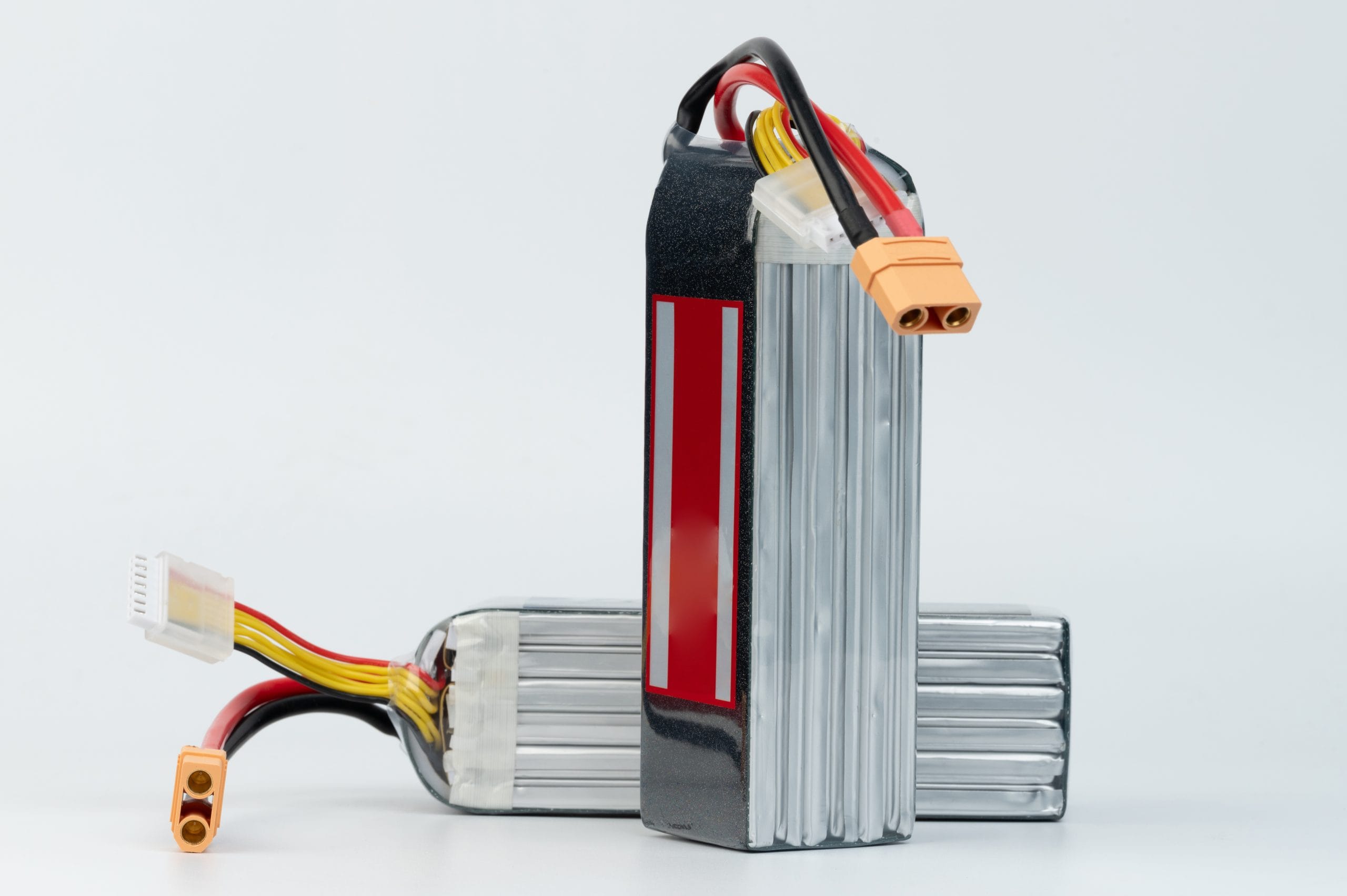
A drone LiPo battery is a lightweight, rechargeable lithium‑polymer (LiPo) battery pack designed to supply high current at relatively high voltage to drone motors, trading cycle life and robustness for very high power‑to‑weight ratio.
What a LiPo battery is #
-
A LiPo battery is a type of lithium‑ion battery that uses a polymer electrolyte in a soft pouch cell, allowing thin, lightweight packs that can be shaped to fit aircraft frames.
-
Each LiPo cell has a nominal voltage of about 3.7 V, is fully charged around 4.2 V, and is typically used between roughly 3.2–4.2 V per cell to avoid damage, which is why packs are built from multiple cells in series for higher voltages.
-
Drones use LiPo packs because they combine high energy density, low mass, and the ability to deliver very high discharge currents, which is critical for rapid throttle changes and aggressive maneuvering.
Cell count (1S, 2S, 3S, 4S, 6S) #
-
The S designation (1S, 2S, 3S, etc.) indicates how many cells are connected in series inside the pack; total pack voltage is approximately 3.7 V×cell count3.7 \text{ V} \times \text{cell count}.
-
Typical examples: 1S ≈ 3.7 V, 2S ≈ 7.4 V, 3S ≈ 11.1 V, 4S ≈ 14.8 V, 5S ≈ 18.5 V, 6S ≈ 22.2 V nominal, with fully charged voltages at 4.2 V×cell count4.2 \text{ V} \times \text{cell count}.
-
In practice, higher‑S packs allow the same power at lower current (P = V·I), reducing conductor losses and sag, but require ESCs and motors rated for the higher voltage and can change the drone’s thrust and handling characteristics.
Capacity (mAh) #
-
Capacity in milliampere‑hours (mAh) specifies how much charge the pack can store and, idealized, how long it can deliver a given current; for example, a 2200 mAh pack theoretically supplies 2.2 A for one hour.
-
Larger mAh values generally increase flight time because the battery stores more energy, but they also increase physical size and mass, which can reduce efficiency and maneuverability if the pack becomes too heavy for the airframe.
-
From an energy standpoint, two packs with the same voltage but different capacities have different total energy content in watt‑hours, so capacity must be matched to the thrust‑to‑weight needs and endurance requirements of the drone.
C rating (discharge rate) #
-
The C rating is a dimensionless multiplier indicating the maximum safe discharge current as a multiple of capacity; the continuous current limit is Imax=C×capacity (Ah)I_\text{max} = C \times \text{capacity (Ah)}.
-
For example, a 1000 mAh (1.0 Ah) pack rated at 30C can theoretically supply about 30 A continuously (30 × 1.0 A), while a 2200 mAh pack at 20C can supply about 44 A (20 × 2.2 A).
-
Higher‑C packs can deliver larger current surges with less voltage sag, which improves throttle response and peak thrust, but they tend to be heavier and more expensive, and operating near their maximum C rating for long periods accelerates degradation.
How cells, mAh, and C interact #
-
For a fixed airframe, increasing cell count (S) raises voltage and changes motor Kv‑matching and prop selection; increasing mAh raises available energy but adds mass; increasing C raises the current headroom at a given capacity.
-
The practically useful current capability of a pack is determined by both capacity and C rating together, so two batteries with the same C but different capacities will have different absolute current limits in amps.
-
Selecting an appropriate drone LiPo thus requires balancing voltage (cells in series), stored energy (mAh), and current capability (C rating) against motor/ESC specifications, desired flight style, and acceptable mass.