
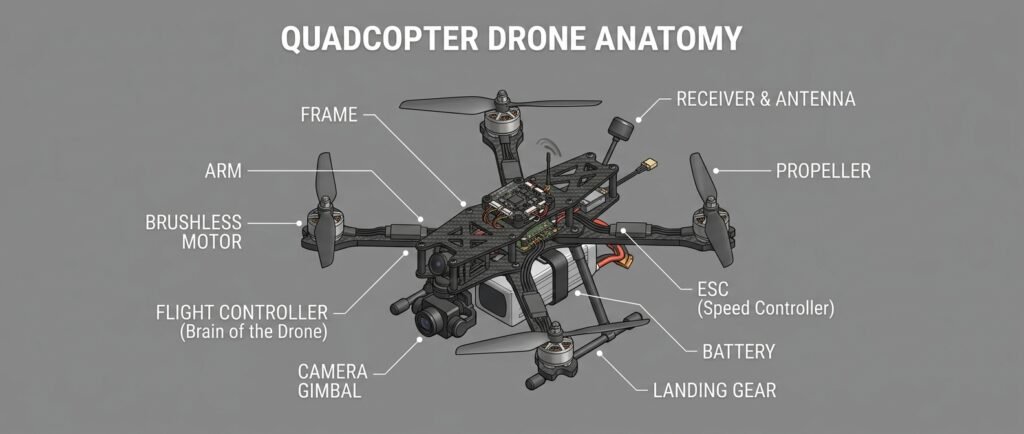
Your video antennas have a huge effect on image quality, often more than VTX power. The most important thing to get right is polarization.
Linear vs. circular polarization
- Linear antennas (a simple dipole or “whip”) radiate in one plane. They work best when the transmitting and receiving antennas line up. When the aircraft rolls, the signal weakens.
- Circular antennas radiate in a corkscrew pattern. They handle the constant rolling and flipping of FPV much better and are less affected by multipath (signals bouncing off buildings and trees).
That’s why most 5.8 GHz FPV video uses circular polarization.
RHCP vs. LHCP
Circular antennas spin either right-hand (RHCP) or left-hand (LHCP).
- The aircraft and goggles antennas must match. An RHCP VTX antenna with LHCP goggles antennas gives a very weak signal.
- RHCP is the most common choice, so it’s the default for most pilots.
- At busy events, some pilots use LHCP to reduce interference from others.
Polarization is usually printed on the antenna or its packaging.
Antenna types
| Type | Pattern | Typical use |
|---|---|---|
| Pagoda / cloverleaf / lollipop | Omnidirectional | On the aircraft; on goggles for nearby coverage |
| Patch | Directional | On goggles, pointed toward where you fly |
| Helical | Highly directional | Ground stations for long range |
On the aircraft, an omnidirectional antenna is almost always used, because it points in every direction as the aircraft moves.
Connectors
Common connectors are SMA, RP-SMA, MMCX and U.FL / IPEX.
- SMA and RP-SMA look similar but don’t mate properly. Check which one your VTX and goggles use.
- U.FL / IPEX is tiny and fragile, so secure the cable to stop it pulling off.
Mounting on the aircraft
- Keep the antenna’s active element clear of carbon fiber, which blocks 5.8 GHz.
- Mount it so it won’t be hit by props and won’t be the first thing to hit the ground.
- Use a TPU antenna mount to hold it securely and protect the connector.
