
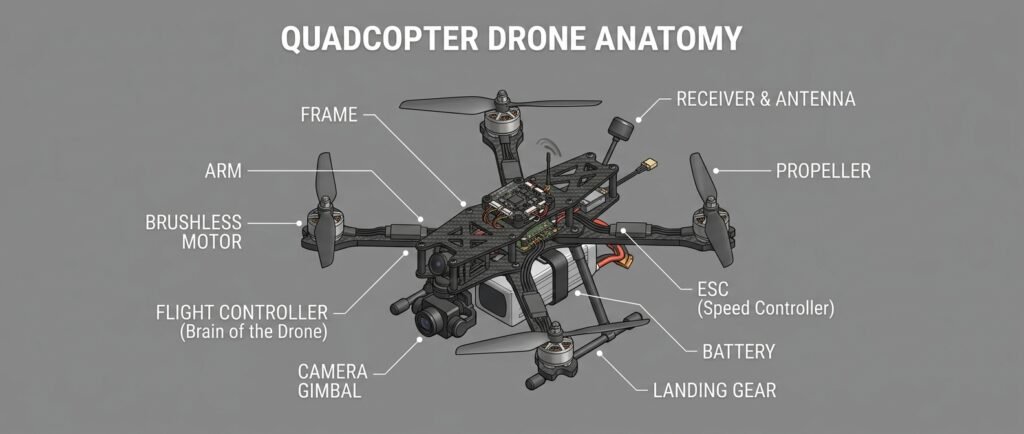
Props are one of the cheapest parts on your aircraft, but they change how it flies more than almost anything else. They’re also the easiest thing to experiment with.
Reading prop codes
A quad prop code such as 5×4.3×3 (or 5143) means:
- 5 = diameter in inches
- 4.3 = pitch in inches
- 3 = number of blades
Plane props use the same idea, usually written as diameter × pitch, for example 6×4 or 8×6.
Diameter
Diameter is the biggest factor in thrust and efficiency. Your frame decides the maximum diameter you can fit. Larger diameters give more thrust and efficiency but need more motor torque.
Pitch
Pitch is how far the prop would move forward in one revolution in an ideal medium.
- Higher pitch: more top speed and “bite”, draws more current, can feel less smooth.
- Lower pitch: smoother, more efficient, better for cruising and cinematic flying.
Blade count
- 2-blade: most efficient; common on long range and planes.
- 3-blade: the freestyle standard; more grip and control.
- 4+ blades: more thrust in a small diameter, but less efficient.
Materials
- Polycarbonate quad props are tough and flexible, and bend rather than shatter.
- Glass-filled nylon and carbon props are stiffer and common on planes and larger builds.
Prop direction
Quad props come in CW (clockwise) and CCW (counter-clockwise) pairs.
- Install props so they match each motor’s spin direction. Betaflight’s default is props in (front props spinning toward the camera); many freestyle pilots use props out to throw debris away from the camera.
- Make sure the leading edge (the thicker, curved edge) leads the rotation.
On planes, make sure the prop is facing the right way. The curved, printed side usually faces forward.
Safety
- Always remove props when working on the bench, flashing firmware or testing with USB.
- Replace props that are chipped, bent or cracked. Damaged props cause vibration and can fail in flight.
- Tighten prop nuts (or check the screws) before every flight.
