
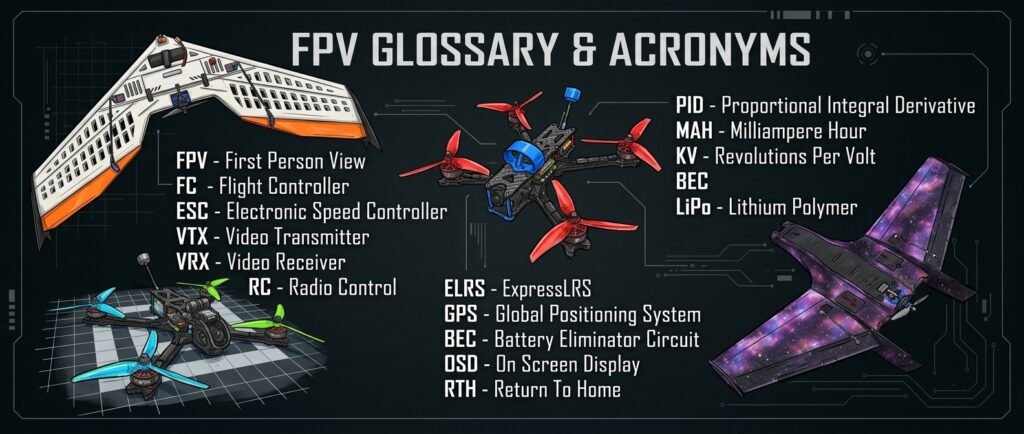
New to FPV, or just hit an acronym you don’t know? This glossary explains the terms and abbreviations you’ll see on product pages, in configurators and at the field, in plain English. Jump to a letter, or use your browser’s find (Ctrl+F / Cmd+F).
# · A · B · C · D · E · F · G · H · I · J · K · L · M · N · O · P · Q · R · S · T · U · V · W · X · Y
Kit types at a glance: RTF, BNF, PNP and ARF
The four labels on a product listing tell you how much is already done for you, from open-the-box-and-fly to bring-your-own-everything.
| Label | Stands for | What’s in the box | You still need | Best for |
|---|---|---|---|---|
| RTF | Ready to Fly | Aircraft, radio, usually goggles, battery and charger | Nothing (maybe a second battery) | Brand-new pilots |
| BNF | Bind and Fly | Complete aircraft with a receiver already installed | A radio that speaks that receiver’s protocol, goggles, batteries | Pilots who already own a radio |
| PNP | Plug and Play | Aircraft with motors, ESC, flight controller and video system (or servos on a plane), but no receiver | A receiver of your choice, radio, goggles, batteries | Pilots who want to pick their own radio link |
| ARF / ARTF | Almost Ready to Fly | Mostly built airframe, often with some power parts | Electronics to install and set up yourself | Builders, most often on planes |
Quick way to remember it: RTF flies out of the box, BNF needs a radio, PNP needs a radio and a receiver, ARF needs a build.
#
900 MHz, 2.4 GHz, 5.8 GHz — The three radio bands you’ll meet most. 2.4 GHz and 900 MHz (868 MHz in Europe) carry the control link; 5.8 GHz carries most video. Lower frequencies travel farther and push through obstacles better but need bigger antennas. Read: FPV Radio and Video Frequencies Explained
31 mm, 40 mm, 65 mm — Prop or frame sizes for tiny whoops. Whoop props are measured in millimeters; frames by their motor-to-motor distance (a 65 mm whoop).
2″, 3″, 5″, 7″ (and so on) — Prop diameter in inches. Pilots also use it as the size class of the whole quad: a “5-inch” is built around 5-inch props. Read: Propeller Specs Explained
4-in-1 ESC — Four ESCs on one board, usually mounted under the flight controller in a stack. Cleaner wiring than four separate ESCs on the arms, but one burnt channel can mean replacing the whole board.
A
AC (Alternating Current) — Current that reverses direction, like the power from a wall outlet. Your charger’s power supply turns it into DC.
ACC (Accelerometer) — A sensor that measures acceleration, including the pull of gravity. The flight controller uses it to know which way is down, which is what self-leveling modes rely on.
Acro (Acrobatic / Rate mode / Manual mode) — No self-leveling: the sticks set how fast the aircraft rotates, and it holds whatever angle you leave it at. Harder to learn, but it’s how almost all freestyle and racing is flown. Read: Acro Mode
Active braking — An ESC feature (called Damped Light in BLHeli) that actively slows the motor when throttle drops instead of letting it coast. It makes throttle changes much sharper.
ADC filter — A setting in EdgeTX and OpenTX that smooths the radio’s stick readings to reduce jitter. Handy for servo-driven planes; many quad pilots turn it off for the lowest latency.
AH (Altitude Hold) — A mode that keeps the aircraft at a set height, usually using the barometer, sometimes GPS or a rangefinder.
AIL (Aileron / Roll) — The roll control, the A in channel orders like AETR and TAER. On a plane it moves the ailerons; on a quad it tilts it left and right.
AIO (All-in-One) — A board that combines the flight controller and ESC, and sometimes the receiver and VTX too. Common on whoops and toothpicks where space and weight matter.
Air Mode — A Betaflight feature that keeps the flight controller correcting even at zero throttle, so the quad stays controllable through flips and dives.
ALT (Altitude) — Height, usually shown on the OSD relative to where you took off.
Analog — The original FPV video system: a simple, very low-latency signal that degrades gradually into static rather than freezing. Cheap and still popular for racing, but far lower image quality than digital.
Angle mode — A self-leveling mode: let go of the sticks and the aircraft levels itself, and it won’t tilt past a set angle. The usual starting point for new pilots. Read: Angle Mode
AoA (Angle of Attack) — The angle between a wing and the air flowing past it. Push it too high and the wing stalls.
AP (Aerial Photography) — Flying to capture smooth stills and video rather than for sport.
APM (ArduPilot Mega) — History: the early Arduino-based board that ran ArduPilot.
ArduPilot — Open-source autopilot firmware for planes, multirotors, VTOLs, rovers and boats. Strong on missions, waypoints and autonomous flight; configured with Mission Planner or QGroundControl.
ARF / ARTF (Almost Ready to Fly) — A mostly built airframe you finish with your own electronics. See Kit types at a glance.
AUW (All-Up Weight) — The total flying weight with battery and everything installed. Also called take-off weight (TOW). Compare dry weight.
AUX (Auxiliary channel) — Any radio channel beyond the four stick channels. AUX1 is channel 5, AUX2 is channel 6 and so on, and they’re usually assigned to switches for arming, flight modes and beepers.
AWG (American Wire Gauge) — Wire size. The bigger the number, the thinner the wire: 12 AWG battery leads, 28–30 AWG signal wires.
B
Band — A named group of video channels (Raceband, Fatshark, Boscam A and so on), usually 8 channels each. Read: Video Transmitters
Bando — Slang for an abandoned building, a favorite freestyle spot. Only fly where you have permission.
BARO (Barometer) — A pressure sensor the flight controller uses to estimate altitude.
BEC (Battery Eliminator Circuit) — A voltage regulator that steps the main battery down to 5 V, 9 V or 12 V for the flight controller, receiver, servos or video gear, so you don’t need a separate battery for them. Read: Power Distribution Boards and BECs Explained
Betaflight (BF) — The most popular flight controller firmware for FPV quads, focused on flight feel for freestyle and racing.
Bind — Pairing a receiver to one specific radio so it only listens to that radio.
BLDC (Brushless DC motor) — The proper name for the brushless motors on FPV aircraft. They’re fed from a DC battery, but the ESC drives them with switched three-phase power.
BLHeli_S, BLHeli_32, Bluejay, AM32 — ESC firmware. BLHeli_S runs on older 8-bit ESCs; Bluejay is its popular open-source successor. BLHeli_32 ran on 32-bit ESCs but is no longer developed; AM32 is the open-source option for that hardware.
BNF (Bind and Fly) — A complete aircraft with a receiver installed; you supply the radio. See Kit types at a glance.
Bootloader — A small permanent program on a chip that lets you load new firmware onto it.
Brushed motor — A simple, cheap motor with physical brushes, found on toy-grade micros. Weaker and shorter-lived than brushless.
Brushless motor — The motor type used on nearly all FPV aircraft: no brushes to wear out, efficient and powerful. Sized by stator dimensions and KV. Read: Brushless Motor Numbers Decoded
Buzzer — A loud beeper for low-battery warnings and for finding a downed aircraft. Self-powered ones keep beeping after the battery ejects. Read: Lost-Model Buzzers
C
C rating — A battery’s claimed maximum discharge rate as a multiple of its capacity (a 1500 mAh 100C pack claims 150 A). Treat it as a rough guide; brands rate very differently.
CAM (Camera) — The FPV camera that feeds your goggles: wide-angle and low-latency, separate from any HD recording camera. Read: FPV Cameras
Cap (Capacitor) — Usually the low-ESR capacitor soldered across the battery pads to absorb voltage spikes, protecting the electronics and cleaning up video. Read: Why Your Quad Needs a Low-ESR Capacitor
CC2500 — The 2.4 GHz radio chip used in many multi-protocol radio modules and older receivers.
CC3D (CopterControl 3D) — History: an early, popular flight controller board.
CG / CoG (Center of Gravity) — The balance point. On a quad it should sit at the middle; on a wing it has to be in the spot the designer specifies or it won’t fly well. Read: Setting the Center of Gravity on an FPV Wing
Channel — Two meanings: a single video frequency your VTX and goggles share, or one control on your radio (throttle, roll, a switch).
Cinelifter — A large quad built to carry a full cinema camera, often with 8 motors in an X8 layout.
Cinewhoop — A small ducted quad built for smooth, close-up filming around people and buildings.
CLI (Command Line Interface) — The text console in Betaflight and INAV for typing commands and backing up settings with dump or diff.
Crius — History: an early MultiWii-era flight controller board.
Crossfire (CRSF) — TBS’s long-range 900 MHz radio system. CRSF is also the name of its serial protocol, which ExpressLRS uses too. Read: TBS Crossfire 50hz vs 150hz
Current sensor (Curr / CRT pad) — Measures how many amps you’re drawing so the OSD can show current and mAh used. CRT or CURR is the pad that carries its signal.
CW / CCW (Clockwise / Counter-clockwise) — Motor and prop spin directions. A quad uses two of each, and props have to match their motor.
D
DC (Direct Current) — Current that flows one way, from positive to negative, like a battery’s. In wiring, negative is also called GND or ground.
DFU (Device Firmware Update) mode — A recovery mode for flashing a flight controller: hold the boot button while plugging in USB. The fix when a board won’t connect normally.
Digital — Digital video systems (DJI, Walksnail, HDZero) send HD video, 720p to 1080p and up, instead of analog’s standard definition. Sharper picture, but a weak signal tends to stutter or freeze rather than fade into static.
Diversity receiver — A receiver with two antennas, or two full receivers, that uses whichever has the better signal at each moment. Fewer dropouts. Read: Video Receivers and Diversity Explained
DJI — Da-Jiang Innovations, the world’s biggest consumer drone maker. In FPV, best known for its O3 and O4 digital video systems and goggles.
DMA (Direct Memory Access) — A hardware channel that moves data without loading the processor. Some Betaflight features, like DShot on a remapped motor pin, need a free DMA channel; two features fighting over one is a DMA conflict.
DOF (Degrees of Freedom) — Older flight controller marketing that counted sensor axes: 6DOF is gyro plus accelerometer, 9DOF adds a compass, 10DOF adds a barometer.
Drone — Any remotely piloted aircraft. Hobbyists often say quad, wing or model instead, since drone covers everything from toys to military aircraft.
Dry weight — Weight ready to fly but without the battery. Compare AUW.
DSM, DSM2, DSMX — Spektrum’s radio protocols. DSMX is the current one.
DSSS (Direct-Sequence Spread Spectrum) — A radio technique that spreads a signal across a wide band to resist interference. Used by DSM2.
DShot — The standard digital ESC protocol: the flight controller sends exact throttle values instead of timed pulses, so there’s no calibration and no noise errors. Bidirectional DShot also reports motor RPM back for RPM filtering.
DVR (Digital Video Recorder) — A recording of what you saw in your goggles, made by the goggles or the video system. Lower quality than an onboard HD camera, but great for finding a crashed aircraft.
E
EdgeTX — Open-source radio firmware that runs on RadioMaster, Jumper and many other transmitters. A community fork of OpenTX, and now the standard. Read: Choosing a Radio Transmitter
EEPROM — Memory that keeps data with the power off. Flight controllers save your settings there, which is why Betaflight says “saving to EEPROM”.
ELEV (Elevator / Pitch) — The pitch control, the E in AETR and TAER. Tilts a quad forward and back, or moves a plane’s elevator.
Elevon — A control surface on a flying wing that does the job of both elevator and aileron. The flight controller or a mixer blends pitch and roll into the two elevons.
ELRS (ExpressLRS) — An open-source radio link that’s become the default choice for FPV: very low latency, long range, and cheap hardware on 2.4 GHz or 900 MHz.
EMI (Electromagnetic Interference) — Electrical noise from motors, ESCs and power wiring that can disrupt video, GPS, compasses and radio. Fixed with routing, distance, twisted wires and capacitors.
Emuflight — A smaller flight controller firmware that split off from Betaflight, aimed at freestyle flight feel.
ESC (Electronic Speed Controller) — Turns the flight controller’s throttle commands into the three-phase power that spins each brushless motor. Read: ESC Basics
Expo (Exponential) — Softens stick response around center so small movements are finer, without changing the maximum rotation rate at full stick.
F
F4, F7, H7 (and F1, F3, G4) — STM32 processor families used on flight controllers. F4 is the budget workhorse, F7 and H7 are faster with more UARTs; F1 and F3 are obsolete. Read: What Is a Flight Controller?
FAA (Federal Aviation Administration) — The US agency that regulates all civil aviation, including drones. Recreational pilots in the US register aircraft over 250 g, pass the TRUST test and follow Remote ID rules.
Failsafe — What the aircraft does when it loses the radio signal: cut motors and drop, hold position, or fly home (RTH). Set and test it before every new build. Read: Long-Range FPV Wing Fundamentals
FC (Flight Controller) — The brain of the aircraft. It reads your radio commands and its sensors and drives the ESCs and servos to fly. Read: What Is a Flight Controller?
FCC (Federal Communications Commission) — The US agency that regulates radio transmitters. It’s why some VTX powers and frequencies need an amateur (ham) license in the US.
FET (Field-Effect Transistor) — The tiny high-current switches on an ESC that turn power to the motor on and off thousands of times a second. Burnt FETs are a common crash casualty.
Flaperon — Ailerons that can also droop together to act as flaps for slower landings.
Flow (optical flow sensor) — A small downward-facing camera that tracks movement over the ground to help hold position without GPS. Often paired with a rangefinder.
FOV (Field of View) — How wide a camera sees, in degrees. FPV cameras run wide, around 150–170°.
FPV (First-Person View) — Flying through a live video feed from a camera on the aircraft, seen in goggles or on a screen, as if you were sitting in it. Read: What Is FPV?
Frame — The structure everything bolts to, usually carbon fiber on quads. Read: Quad Frame Geometry
Freestyle — Flying for tricks and flow rather than racing. Also the name for quads built for it.
FTDI — A brand of USB-to-serial chip, and the common name for the adapters built on it. Used to flash or talk to devices that have no USB port.
FW (Firmware) — The software that runs on a piece of hardware: Betaflight on an FC, Bluejay on an ESC, EdgeTX on a radio.
G
GCS (Ground Control Station) — Software on a laptop or tablet for monitoring and commanding an autopilot in flight, like Mission Planner or QGroundControl.
Gimbal — Two meanings: the stick assembly inside your radio, or a motorized mount that keeps a camera steady.
GND (Ground) — The negative side of a DC circuit. Every device in a build needs a shared ground.
Goggles — The headset with screens that shows your FPV video.
GPS — Satellite positioning. Lets the flight controller know where it is for position hold, return to home and finding a lost aircraft. Read: GPS for FPV
Ground effect — Extra lift and turbulence when hovering low, as prop air bounces back off the ground.
Gyro (Gyroscope) — The sensor that measures how fast the aircraft is rotating on each axis. It’s the flight controller’s most important sensor.
Gyroflow — Free, open-source software that stabilizes footage using gyro data recorded by the camera or flight controller.
H
HDZero — A digital FPV system known for having the lowest, fixed latency of the digital options. Popular for racing.
HEXA (Hexacopter) — A multirotor with six motors.
HobbyKing (HK) — A long-running RC retailer.
Horizon mode — Self-leveling like Angle mode near center stick, but lets the aircraft flip and roll at full stick. Read: Horizon Mode
HV / LiHV (High-Voltage LiPo) — LiPo cells that charge to 4.35 V instead of 4.20 V, for a little more punch. Only charge them on a charger set to LiHV.
I
I2C — A two-wire bus for connecting low-speed sensors like compasses, barometers and airspeed sensors to the flight controller. Several devices can share it.
IMD (Intermodulation Distortion) — Interference created when two transmitters’ frequencies mix. It’s why groups flying together pick video channels with spacing in mind.
IMU (Inertial Measurement Unit) — The gyro and accelerometer chip on the flight controller.
IntoFPV, RCGroups (RCG) — Long-running online forums for RC and FPV.
IPEX / U.FL — Tiny snap-on antenna connectors used on receivers and small VTXs. IPEX comes in several sizes; IPEX1 (MHF1) is the same as U.FL. They wear out after a few connections.
J
Jello — Wobbly, warped footage caused by vibration reaching the camera. Fix it with balanced props, soft mounting or better tuning.
JST — A family of small connectors. JST-PH and PH2.0 for whoop batteries; JST-SH and JST-GH for signal wiring between boards and peripherals.
K
Kalman filter — A math technique for combining noisy sensor readings into a cleaner estimate. Flight controllers use variants to filter gyro data and estimate attitude.
KK, MultiWii, MegaPirate, Revo — History: early flight controllers and firmware from the 2010s that today’s boards grew out of. KK boards were designed by Rolf Bakke; MultiWii began on Wii-remote sensors; MegaPirate was an ArduCopter port; Revo was the OpenPilot Revolution board.
KV — A motor’s rpm per volt with no load. Higher KV spins faster and suits lower-voltage packs; 6S builds use lower KV than 4S builds. Read: Brushless Motor Numbers Decoded
L
Launch mode — An INAV and ArduPilot feature for hand- or bungee-launching a wing: it waits for the throw, then runs the motor and climbs out on its own before handing control back.
LC filter — An inductor and capacitor that smooth noisy power, usually feeding a camera or VTX to clean up video lines.
LED — Light-emitting diode. On aircraft, usually addressable LED strips for orientation, status and visibility.
LHCP / RHCP — Left- and right-hand circular polarization for antennas. Neither is better, but transmit and receive antennas must match, or you lose a lot of signal. Read: FPV Antenna Polarization
Li-ion (Lithium-ion) — Cells like 18650s and 21700s. More energy per gram than LiPo but much lower current, so they suit long-range cruising, goggles and radios, not freestyle.
LiPo (Lithium Polymer) — The standard FPV battery: light and able to deliver very high current, but it needs careful charging and storage. Read: How to Charge LiPo Batteries Safely
Locked in — Praise for an aircraft that tracks exactly where you point it, as if on rails.
LOS (Line of Sight) — Flying while looking at the aircraft directly rather than through goggles.
LPF (Low-Pass Filter) — A filter that cuts high-frequency noise from gyro and D-term data. Too much filtering adds delay; too little sends noise to the motors.
LQ (Link Quality) — The percentage of radio packets arriving intact. A better warning sign than RSSI on modern links like ELRS and Crossfire.
Lua script — A small add-on program that runs on an EdgeTX radio, like the ELRS or Betaflight configuration screens.
M
MAG (Magnetometer / compass) — Senses the earth’s magnetic field so the flight controller knows which way it’s pointing. Needed for reliable GPS navigation on multirotors; keep it away from power wires.
mAh (milliamp-hour) — Battery capacity. A 1500 mAh pack can supply 1.5 A for one hour, or 15 A for six minutes.
Mixer — The settings that turn your stick inputs into individual motor and servo outputs, such as blending pitch and roll for elevons or setting a quad’s motor layout.
MMCX — A small snap-on antenna connector that swivels. Sturdier than U.FL, smaller than SMA; common on video transmitters.
Mode 1 / Mode 2 — Radio stick layouts. Mode 2, throttle and yaw on the left stick, is standard in the US and most of the world.
MSP (MultiWii Serial Protocol) — The serial protocol flight controllers use to talk to configurators, digital VTX OSDs and other peripherals.
MTOW (Maximum Take-Off Weight) — The heaviest an aircraft is rated to fly at, including payload.
N
Naked GoPro — A GoPro stripped from its case down to the board and lens to save weight on small quads.
NC (Not Connected) — A pin or pad label meaning nothing is wired to it.
O
OCTO (Octocopter) — A multirotor with eight motors. See also X8.
Oneshot, Multishot — Older analog ESC protocols that sped up classic PWM. Replaced by DShot.
OpenTX — The radio firmware EdgeTX grew out of. No longer actively developed.
Opto ESC — An ESC with no built-in BEC.
OSD (On-Screen Display) — Flight data overlaid on your video: battery voltage, timer, link quality, altitude, GPS distance and more.
P
P (Parallel) — Cells wired side by side in a pack to add capacity. A 4S2P pack is two 4S packs in parallel.
Pack — Short for battery pack.
PAL / NTSC — The two analog video standards. Your camera and goggles should match; PAL has slightly more lines, NTSC a slightly higher frame rate.
Parallel charging — Charging several packs at once through a parallel board. Only connect packs with the same cell count and similar voltage.
Payload — What the aircraft carries beyond what it needs to fly, like a camera.
PCB (Printed Circuit Board) — The board almost every electronic part is built on: FC, ESC, VTX, receiver.
PDB (Power Distribution Board) — A board that spreads battery power to ESCs and other components, often with BECs and a current sensor built in. Read: Power Distribution Boards and BECs Explained
PID (Proportional, Integral, Derivative) — The three-part control loop the flight controller uses to match what the aircraft is doing to what your sticks ask for. Tuning PIDs changes how locked-in, smooth or twitchy it feels. Defaults suit most beginners.
Pigtail — A short lead soldered to a board, most often the battery lead on an ESC. Also a short antenna adapter cable.
Pitch (propeller) — How far a prop would move forward in one full turn, in inches. More pitch means more top speed but more current draw.
PNP (Plug and Play) — An aircraft with everything but the receiver. See Kit types at a glance.
Polarization — The orientation of a radio wave: linear or circular. Matching it between antennas matters more than which type you pick. Read: FPV Antenna Polarization
PPM / CPPM (Pulse Position Modulation) — An older way to send all receiver channels down one wire. Replaced by serial protocols like CRSF and SBUS.
Prop (Propeller) — Described as diameter × pitch × blades: a 5×4.3×3 is 5 inches across, 4.3-inch pitch, three blades. Read: Propeller Specs Explained
Prop wash — Shaking when the aircraft flies back through its own turbulent air, usually after a flip or a dive. Reduced with tuning.
Proximity — Flying close to objects, trees and the ground. Read: Proximity Flying
Punch / Punch-out — A sudden burst of full throttle, often straight up.
Pusher — A prop mounted at the back, pushing the aircraft. Most FPV wings are pushers so the prop stays clear of the camera and the ground on landing.
PWM (Pulse Width Modulation) — The classic signal that drives servos and older ESCs, one wire per channel.
Q
Quad (Quadcopter) — A multirotor with four motors. The most common FPV aircraft.
R
Rates (RC rate, super rate) — Settings for how fast the aircraft rotates for a given stick movement. Higher rates feel more twitchy; your max rate sets how fast a full-stick flip or roll happens.
ReelSteady — GoPro’s stabilization for FPV footage, now built into GoPro’s apps.
Reflex — A slight upward bend at the trailing edge of a flying wing’s airfoil, or elevons trimmed slightly up. It keeps a tailless wing stable in pitch.
Remote ID — The FAA rule requiring most drones to broadcast their identity and location in flight, either built in or through an add-on module. Flying at an FAA-recognized field (FRIA) is the main exception.
RF (Radio Frequency) — Radio signals in general, or a specific band like 2.4 GHz or 900 MHz.
RPM — Revolutions per minute, how fast a motor spins.
RPM filter — A Betaflight feature that uses each motor’s real-time RPM (from bidirectional DShot) to filter motor noise precisely. One of the biggest upgrades to quad flight feel in years.
RSSI (Received Signal Strength Indicator) — How strong the radio signal is at the receiver. Useful, but LQ tells you more about whether the link is actually working.
RTF (Ready to Fly) — Everything in the box, flies out of the box. See Kit types at a glance.
RTH / RTL (Return to Home / Return to Launch) — A GPS feature that flies the aircraft back to where it took off, either on command or automatically on failsafe. Read: GPS for FPV
RUD (Rudder / Yaw) — The yaw control, the R in AETR and TAER. Turns a quad’s nose left and right.
RX (Receiver) — The radio receiver on the aircraft. RX is also the receive pin of a UART: wire RX on one device to TX on the other. Read: Receiver Antenna Placement
S
S (cell count) — How many cells are wired in series. Each LiPo cell is 3.7 V nominal and 4.2 V full, so a 4S pack is 14.8 V nominal and 16.8 V full; a 6S is 22.2 V and 25.2 V. Your ESC, motors and other electronics must be rated for it. Read: LiPo Voltage Chart
SBUS — Futaba’s serial receiver protocol, also used by FrSky. It carries 16 channels on one wire and is inverted, which some flight controllers need to handle in hardware.
Servo — A small motor with built-in position control that moves a control surface. The workhorse of fixed-wing builds.
Servo throw — How far a control surface moves at full stick. Set it with your servo arm and control horn holes and with endpoints in the radio or flight controller.
SimonK — History: early open-source ESC firmware, replaced by BLHeli and its successors.
SMA / RP-SMA — Screw-on antenna connectors. RP-SMA swaps the pin to the other side, so the two don’t mate; check before you buy an antenna.
SmartAudio / Tramp (VTX control) — Protocols that let the flight controller change your analog VTX’s channel and power from the OSD or radio.
Stack — A flight controller mounted above a 4-in-1 ESC on standoffs, often sold as a matched combo. The standard layout on 5-inch quads.
Stall — When a wing’s angle of attack gets too high, the airflow separates and the wing suddenly loses lift. On a wing, the usual cure is to lower the nose and add speed.
T
TAER / AETR — Channel order: which of the first four channels carries throttle, aileron (roll), elevator (pitch) and rudder (yaw). The radio and flight controller must agree. Betaflight and ELRS typically use AETR.
Telemetry — Data the aircraft sends back to your radio, like battery voltage, link quality, GPS position and altitude, so the radio can show it and call out warnings.
Throttle — Controls overall motor power, the T in TAER. On a quad it controls climb and descent; on a plane, speed.
Thrust — The push a motor and prop produce, usually listed in grams on thrust charts.
Tiny Whoop — A tiny ducted quad, about 65–75 mm, safe enough to fly indoors.
Toothpick — An ultralight micro quad on 2.5–3.5-inch props with no ducts. Light enough to fly in places a 5-inch can’t.
TRI (Tricopter) — A multirotor with three motors and a servo that tilts the tail motor for yaw.
Trim — A small fixed offset on a control to stop drift. On planes it’s set mechanically or by trim switches; on quads, fix the cause instead.
TVL (TV Lines) — A measure of analog camera resolution. Higher is sharper, though analog video transmission limits what you’ll actually see.
TX (Transmitter) — Your radio, or the transmit pin of a UART (TX on one device goes to RX on the other). Read: Choosing a Radio Transmitter
U
UART — A serial port on the flight controller (UART1, UART2 and so on) for receivers, GPS, VTX control and telemetry. More UARTs means more devices without compromises.
UAV (Unmanned Aerial Vehicle) — The official term for an aircraft with no pilot onboard.
UBEC — A standalone BEC on its own small board, usually powering servos on planes. See BEC.
V
V-tail — On a quad: two rear motors angled into a V. On a plane: two tail surfaces in a V that blend rudder and elevator (ruddervators).
Vcc — The positive supply pin or pad on a board.
VRX (Video Receiver) — Receives your VTX’s signal and passes it to your goggles or screen. Read: Video Receivers and Diversity Explained
VTOL (Vertical Take-Off and Landing) — An aircraft that takes off like a multirotor and flies like a plane.
VTX (Video Transmitter) — Sends the camera feed from the aircraft to your goggles in real time. Read: Video Transmitters
W
Walksnail (Avatar) — Maker of the Avatar HD digital FPV system, part of Caddx.
Wing / flying wing — A tailless plane where the wing does everything, controlled by elevons. The most popular FPV fixed-wing layout. Read: Long-Range FPV Wing Fundamentals
WOT (Wide Open Throttle) — Full throttle.
X
X8 — Eight motors on four arms, one up and one down on each, like a stacked quad. Common on cinelifters.
XT30, XT60, XT90 (and XT60H) — The standard battery connectors, sized by current: XT30 for small quads, XT60 for most 5-inch builds, XT90 for big rigs. XT60H adds a snap-on back cover. Read: Battery Connectors: XT30, XT60 and XT90 Compared
Y
Y4 — A four-motor layout with two arms up front and two coaxial motors on a single tail boom.
