
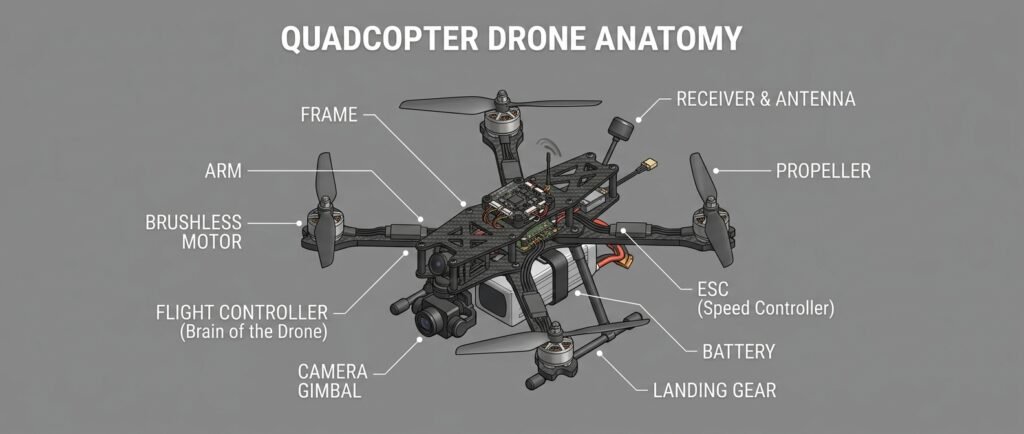
An ESC (Electronic Speed Controller) turns the throttle commands from your flight controller into the three-phase power that spins a brushless motor. Every brushless motor needs one, either as a single ESC per motor or combined on one board as a 4-in-1 ESC.
4-in-1 vs. individual ESCs
| Type | Pros | Cons |
|---|---|---|
| 4-in-1 | Clean build, lighter, stacks under the FC | One burnt channel can mean replacing the whole board |
| Individual | Replace one at a time; better cooling on arms | More wiring and weight |
Quads usually use 4-in-1 ESCs. Planes and wings usually use a single individual ESC.
ESC firmware
The firmware running on the ESC affects smoothness, features and protocol support:
- BLHeli_S: the long-running standard on budget 8-bit ESCs.
- Bluejay: open-source firmware for BLHeli_S hardware. It adds bidirectional DShot (RPM telemetry), which enables Betaflight’s RPM filtering.
- BLHeli_32: popular 32-bit firmware. Its development has ended, so new ESCs are moving to alternatives.
- AM32: open-source firmware for 32-bit ESCs, now common on new hardware.
Protocols: how the FC talks to the ESC
- PWM / OneShot / Multishot: older analog-style signals that need calibration. Still common for planes.
- DShot (DShot300, DShot600): a digital protocol. No calibration, error-checked and precise. This is the standard on quads.
- Bidirectional DShot: the ESC also sends motor RPM back to the FC, which Betaflight uses for very effective noise filtering.
Sizing current ratings
ESCs list a continuous and a burst current rating (for example “45A / 55A burst”).
- Check your motor’s maximum current with your intended prop and battery (from thrust tables).
- Choose an ESC whose continuous rating comfortably exceeds that, with headroom of 20–30%.
- Make sure the ESC supports your battery’s cell count (for example 3–6S).
Undersized ESCs run hot and fail, often taking the rest of the stack with them.
Protecting your ESC
- Fit a low-ESR capacitor across the battery pads to absorb voltage spikes.
- Use a smoke stopper the first time you power up a new build.
- Keep ESC firmware and motor timing settings at their defaults unless you know why you’re changing them.
