
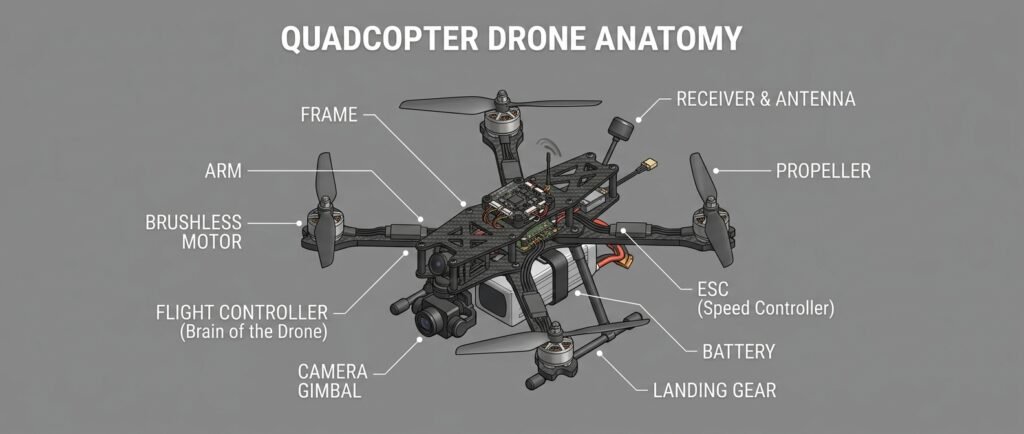
FPV uses two separate radio links: a control link from your radio to the aircraft, and a video link from the aircraft back to your goggles. Here are the terms and frequencies you’ll see most often.
Common radio and video terms
| Term | Meaning |
|---|---|
| RC | Radio Control |
| Rx | Receiver (on the aircraft, for your control link) |
| VTX | Video Transmitter (on the aircraft) |
| VRX | Video Receiver (in your goggles or ground station) |
| RSSI | Received Signal Strength Indicator: how strong the incoming signal is |
| LQ | Link Quality: the percentage of control packets getting through |
| RTH | Return to Home |
| MHz / GHz | Megahertz / Gigahertz, units of radio frequency |
| CRSF | The Crossfire protocol from TBS, used between the receiver and flight controller and by TBS Crossfire and ExpressLRS systems |
| SBUS | A serial protocol (originally from Futaba) that carries all channels between the receiver and flight controller on one wire |
| dBi | Antenna gain |
Typical frequencies
| Use | Common frequencies |
|---|---|
| Control link | 433 MHz, 868/915 MHz, 2.4 GHz (most common) |
| Analog video | 900 MHz, 1.3 GHz, 2.4 GHz, 5.8 GHz (most common) |
Lower frequencies generally penetrate obstacles better and reach farther. That’s a rule of thumb, not a guarantee, but it’s a useful one to keep in mind. It’s also why your control link should never be on a higher frequency than your video: see FPV Build Rules.
Antenna gain: range vs. coverage
- Omnidirectional antennas send and receive in all directions. They have lower gain and less range, but a solid signal all around you, especially up close.
- High-gain (directional) antennas focus on one direction. They reach much farther that way, but the signal drops off quickly outside that beam.
- Higher dBi = more range in a narrower area. Lower dBi = less range but better coverage close in.
For most quad FPV flying, a ~3 dBi omnidirectional antenna on your video receiver, paired with a quality VTX and a ~3 dBi omni on the aircraft, is all you need.
